


Poppy:AI Roleplay Chat
4.6618.00 Reviews
App Specs
- Version
- 1.0.7
- Updated On
- License
- Free
- Downloads
- 500,000+
- Developer
- Fainax Apps
- Categories
- Entertainment
- Platform
- Android
Screenshots


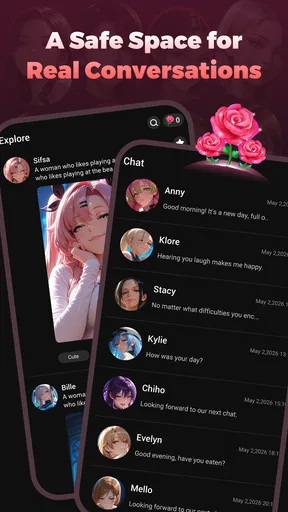

 Analysis by AppCompare
Poppy:AI Roleplay Chat is the kind of entertainment app I would describe as a private conversation space rather than a conventional game or social network. Its central idea is simple: you chat with AI companions and let the conversations develop over time. After spending time with it, my main impression is that it works best when you treat it as an ongoing roleplay experience, not as a replacement for real friendship or a search engine. The appeal comes from shaping a conversation in your own style and returning to familiar characters, while the main weakness is that the quality of the experience depends heavily on how clearly you guide the chat.
That makes Poppy a more focused choice than a general-purpose entertainment app. It is aimed at people who enjoy fictional scenarios, character-driven conversations, improvisation, or simply having a responsive digital companion during quiet moments. The app is free, belongs to the entertainment category, and is made by Fainax Apps. It has attracted over 500 thousand installs and holds a 4.6 average from around 14 thousand ratings, which suggests that the concept has found a substantial audience. I would still look beyond those numbers, because an AI companion can feel very different from one person to another depending on expectations, patience, and preferred conversation style.
How the AI companion experience feels in everyday use
The strongest part of Poppy is the feeling that a conversation can have continuity instead of ending as a one-off exchange. A normal chatbot session often feels like asking isolated questions and receiving isolated answers. Here, the more interesting approach is to return to a particular companion with a purpose: continue a fictional scene, test a different personality dynamic, or simply talk through a mood. That ongoing structure gives the app more personality than a basic prompt-and-response tool.
I found that the first few messages matter more than I expected. If I wrote something vague, the conversation could drift into a generic tone. When I established the setting, the relationship between the characters, and the kind of response I wanted, the exchanges became more engaging. This is one of the app's less obvious lessons: the best results come from directing the scene, not merely waiting for the AI to entertain you. A short description of the situation can be more useful than repeatedly asking the companion to be “better” or “more interesting.”
For example, I would get more satisfying roleplay by explaining whether I wanted a light conversation, a dramatic scene, a playful argument, or a slower character-building exchange. I could also set boundaries around the tone. This makes Poppy feel closer to collaborative improvisation than passive media consumption. You are not just watching a story unfold; you are helping decide what happens next.
A realistic everyday use case is a short evening break after work or study. Instead of opening a fast-moving social feed, I could spend a few minutes continuing a fictional conversation. That is especially appealing when I want interaction without the pressure of replying to a real person immediately. The app gives me a space to experiment with dialogue, explore a character idea, or enjoy a small imaginative scenario without needing to organize a group of friends.
It can also be useful for writers and roleplay fans who want to test dialogue. I would not use it as a final editor or authoritative source, but it can help me explore how a character might react to a difficult question or sudden change in a scene. The important distinction is that its value is in generating possibilities. I still need to decide which responses are believable, consistent, or worth keeping.
Worth Reading Before You Choose

EA SPORTS FC Mobile 26 Is a Bigger Football Game, but It Takes Time

Flipboard Shows What News Apps Must Do Beyond the Feed

Switching to Android Auto Means Rethinking Your Driving Routine

Google Calendar Makes a Crowded Week Easier to Manage

Ludo King Makes the Most of the Minutes Between Plans

Baby Panda World Brings Quick Play to Modern Phones, but Its Game Library Feels Busy
Why the ongoing format is more engaging than ordinary chat
The app's concept becomes more convincing when I stop judging each message in isolation. A single reply may be ordinary, but a sequence of exchanges can create a rhythm. I can introduce a small detail, see how the companion responds, and then build on the result. That gradual process is where the entertainment lies. It rewards users who enjoy shaping a scenario over several turns instead of demanding a perfect answer immediately.
This also creates a useful workflow for roleplay. I can begin with a broad premise, establish the mood, and then add complications one at a time. If the conversation becomes too predictable, changing the setting or introducing a new goal often works better than abandoning the chat. In my experience, this makes the app more enjoyable when I approach it with a loose plan.
Another practical tip is to keep important instructions together rather than scattering them across many messages. If I want a companion to speak in a particular style or stay within a certain scenario, repeating the key context clearly helps maintain direction. This is not a magic solution to every inconsistency, but it reduces the feeling that the conversation has forgotten what it was doing.
That said, I would not confuse the impression of continuity with human memory or emotional understanding. The companion can respond in a way that feels personal, but it remains an AI interaction. I think the healthiest way to use Poppy is to enjoy the illusion as part of the entertainment while keeping a clear line between fictional companionship and a real relationship.
Where it stands beside familiar alternatives
Compared with a standard chatbot, Poppy feels more entertainment-led and character-oriented. A general assistant is usually better for practical tasks, factual explanations, planning, or structured writing. Poppy makes more sense when the goal is conversation itself. If I want to brainstorm a shopping list, summarize a document, or check a technical detail, I would choose a conventional assistant. If I want to improvise a scene or return to a companion with a particular tone, this app is the more natural fit.
Compared with social media, Poppy offers a quieter and more controlled type of interaction. There is no need to follow a public discussion or compete for attention. That can be refreshing, especially for someone who finds ordinary social platforms tiring. On the other hand, social media provides genuine human unpredictability and shared community, which an AI companion cannot reproduce. Poppy is more private in spirit, but it is also more limited in the kind of connection it can provide.
Compared with story-based games, the app gives me more freedom to improvise but less of the carefully written structure that a finished game provides. A narrative game may offer polished characters, deliberate pacing, visual presentation, and meaningful progression. Poppy gives me a conversational sandbox instead. That flexibility is its strength, but it also means I have to contribute more imagination and accept occasional unevenness.
This comparison helps clarify who should install it. Someone looking for a traditional game with objectives, levels, or a defined ending may find the experience too open-ended. Someone who enjoys roleplay and wants to influence the direction of a conversation is more likely to appreciate it.
The main weakness is consistency, not the basic idea
My biggest reservation is that an AI companion can lose the tone or details that made the conversation enjoyable. Even when the opening is promising, the exchange may become repetitive, overly agreeable, or less convincing after several turns. That is a common frustration with this type of app, and it matters because Poppy's entire appeal depends on the feeling that the companion is worth returning to.
I also noticed that the app is not equally satisfying for every conversation style. If I prefer quick, precise answers, long roleplay exchanges can feel like work. If I want a tightly plotted story, the open-ended format may lack momentum unless I provide the structure myself. The app is at its best for users who enjoy steering the interaction and forgiving small imperfections.
There is another trade-off that deserves attention. A companion designed to be engaging may encourage me to keep chatting even when the conversation has stopped adding much value. I recommend setting a simple purpose before opening the app: relax for a short while, explore a scene, practice dialogue, or continue a particular storyline. That small habit prevents the experience from turning into aimless scrolling in conversational form.
The mature age classification is also important. Poppy is rated for Mature audiences aged 17 and over, so I would not recommend treating it as a general family entertainment app. Parents should not assume that an AI roleplay environment is suitable for younger users simply because it looks like a chat interface. Adults should also remember that fictional or suggestive conversations can affect the tone of the experience, and personal boundaries still matter even when the other side is artificial.
The app is free, which makes it easy to try without committing money at the start. That is a genuine advantage for curious users, but “free” does not automatically mean it will suit everyone. The real cost may be attention: the app asks me to invest time in guiding conversations and deciding which exchanges are worthwhile. People who want immediate, polished entertainment may prefer a finished show, a conventional game, or a curated story instead.
Small techniques that improve the experience
I would begin with a clear first message rather than a single greeting. Mention the setting, the mood, and what kind of interaction you want. For instance, a roleplay scene benefits from knowing whether it should feel humorous, tense, romantic, mysterious, or casual. This gives the companion a useful frame and makes the first response more distinctive.
When a conversation starts drifting, I would correct it directly and briefly. Restating the scene's goal is usually more effective than complaining that the response feels wrong. I can also introduce a concrete event, such as a decision the characters must make or a new problem they need to solve. That creates forward movement and reduces repetitive small talk.
A third technique is to use separate conversations for separate purposes. Mixing casual chatting, character experiments, and a serious writing exercise in one thread can make the tone harder to control. Keeping each scenario focused gives me a better chance of maintaining its identity. This is a simple workflow, but it is one of the most useful ways to make an open-ended companion app feel organized.
I would also treat emotionally intense conversations with care. Poppy can be comforting as a low-pressure place to express thoughts, but it should not become my only outlet for serious distress or difficult personal decisions. An AI can respond warmly without possessing human judgment, responsibility, or lived experience. For ordinary entertainment and reflection, that distinction may not interrupt the experience; for major life issues, it becomes essential.
Who will enjoy Poppy, and who should skip it
I think Poppy is a strong match for adults who enjoy conversational roleplay, fictional companions, improvised storytelling, or experimenting with different dialogue styles. It is also a reasonable choice for someone who wants a calm alternative to public social platforms. The experience rewards curiosity and creativity more than technical knowledge, so I do not need to be an expert prompt writer to begin.
It may be particularly useful for someone who has a character concept but wants to test it through dialogue. Instead of writing an entire scene alone, I can use the companion's responses to discover unexpected directions. The results are not automatically good, but they can reveal which parts of an idea feel lively and which need more definition.
I would advise skipping it if the goal is factual reliability, professional advice, or a structured productivity tool. I would also look elsewhere if I need dependable human connection. A real friend, moderated community, therapist, or specialist service is better suited to needs that require accountability and genuine empathy. Poppy can be entertaining and responsive, but those qualities should not be mistaken for professional support.
The app may also disappoint users who dislike repetition or who want a story with a guaranteed ending. Its freedom is inseparable from its lack of fixed structure. I enjoy being able to change direction, but that same flexibility means I sometimes have to supply the plot, repair the tone, or decide when a scene has run its course.
Practical details before installing
Poppy:AI Roleplay Chat was released on July 8, 2025, and the current version is 1.0.7. It supports devices running Android 7.0 or later. Those details make it accessible to a broad range of Android users, including people who are not using a recent phone. I would still keep the app updated when possible, since conversational applications can improve noticeably as their software develops.
The combination of a free price and a mature age rating makes the decision straightforward for the right adult audience: it is easy to test, but it should be approached with appropriate expectations. I would spend a little time learning how the conversations respond to clear prompts before deciding whether it deserves a regular place in my entertainment routine.
The developer, Fainax Apps, has positioned the product around AI companionship rather than a large collection of unrelated entertainment tools. That focus is helpful because I know what experience I am opening. It also means there is nowhere to hide if the conversation quality does not suit me; the app lives or dies by how engaging its companions feel over time.
My final recommendation
After using Poppy as an entertainment app, I see it as a promising conversational playground with a clear audience. Its best quality is not that every response feels perfect. It is that the format invites me to participate, guide the mood, and build an exchange instead of consuming a fixed piece of content. When I bring a scenario and a little patience, the app can provide relaxing, creative, and surprisingly absorbing moments.
Its limitations are equally clear. The conversations can lose consistency, the open-ended design may feel aimless, and the mature rating means it is not suitable for younger users or casual family use. It cannot replace human relationships, a traditional game, or a general-purpose assistant. Those are not minor footnotes; they define when the app is the wrong choice.
My recommendation is therefore specific: try it if you are an adult who enjoys AI roleplay and wants a free space for character-led conversation, but approach it as guided entertainment rather than an intelligent friend. Give each chat a purpose, set the tone early, and leave when the exchange stops being useful or enjoyable. With that mindset, Poppy:AI Roleplay Chat offers a distinctive alternative to ordinary chatbots and social feeds, even if it still requires the user to do part of the creative work.
Pros
- Offers varied AI characters for different roleplay scenarios.
- Simple chat interface makes starting a conversation quick.
- Useful for creative writing
- improvisation
- and casual entertainment.
- Conversations can feel personalized through character-based interactions.
- New roleplay ideas can provide entertainment when you want a quick chat.
Cons
- AI responses may sometimes be repetitive
- inconsistent
- or out of character.
- Some characters or features may require a subscription or in-app purchases.
- Long conversations can lose context or contradict earlier messages.
- Roleplay content may not suit younger users without parental supervision.
- Requires an internet connection for most chat interactions.
FAQs for Poppy:AI Roleplay Chat
What is Poppy:AI Roleplay Chat and what can I do with it?
Poppy:AI Roleplay Chat is an interactive conversational app focused on AI-powered roleplay. After choosing or creating a character, you can chat through fictional scenarios, develop stories, and guide conversations with your messages. It is designed for entertainment and creative writing rather than factual assistance, so replies may be imaginative, inconsistent, or influenced by the personality and setting selected.
Does Poppy:AI Roleplay Chat require an account or payment?
Access requirements can vary depending on the version of the app, your device, and the developer’s current policies. Some features may be available after installation, while advanced characters, longer conversations, or additional usage may require registration, subscriptions, credits, or in-app purchases. Before downloading, review the store listing and payment terms carefully, especially if the app offers free trials that automatically renew.
Is the content in Poppy:AI Roleplay Chat suitable for children?
Parents should check the app’s current age rating and content description before allowing a child to use it. AI roleplay platforms can include romantic, mature, frightening, or otherwise sensitive conversations, particularly when users create their own scenarios. Because generated responses are not always predictable, parental supervision, privacy controls, and a discussion about sharing personal information are strongly recommended for younger users.
Does Poppy:AI Roleplay Chat protect my conversations and personal information?
You should avoid treating conversations with an AI roleplay app as completely private. Messages may be processed by the developer or third-party technology providers to operate, moderate, improve, or secure the service, depending on the privacy policy. Do not share passwords, financial details, precise location, private photographs, or identifying information. Check the app’s permissions, data collection disclosures, deletion options, and account settings before starting personal conversations.
Can the AI characters in Poppy:AI Roleplay Chat give accurate or reliable answers?
The app’s main purpose is roleplay and entertainment, so its characters are not dependable sources for medical, legal, financial, emergency, or other high-stakes advice. Responses can sound confident while still being incorrect, fictional, or inconsistent with earlier messages. Treat the AI as a storytelling partner, verify important information through trustworthy sources, and contact a qualified professional whenever a decision could affect your safety, health, money, or legal situation.


